Showing posts with label monuments. Show all posts

17 June 2009

Paris in August! Can you imagine?

One of my favorite sculptures in the Louvre: 'Psyche Revived by Cupid's Kiss' by Antonio Canova


We arrived at the catacombs just half an hour after it opened, but the line was already wrapped around the block. We entertained ourselves by prepping for our upcoming Amsterdam excursion and watching three men lay cobblestones in the street. Our fellow queuers (No, it's not a word, I made it up. It means "one who queues") entertained themselves by pulling their lunches out of their bags and backpacks, ripping the food into pieces, and sprinkling it on the concrete for the pigeons. The pigeons billed and cooed and showed their appreciation by pooping on people's shoes.

Disgusting creatures.

Queue at the catacombs

It took a really long time, but finally we got to enter the Halls of the Dead.


A long time ago (late 18th century), the cemeteries of Paris were overflowing and contaminating the fair city through mass graves and improper burial. The medieval cemeteries were condemned and the millions of inhabitants were moved to underground caves and tunnels by night.


Entrée de l'ossuaire: "Stop! This is the Empire of the Dead."

As an anatomy student, I found it interesting that the skulls, femurs, tibias, and humeri (head, thigh, shin, arm) were stacked in patterns. Behind this virtual walls of bones were piled the collections of less-decorative skeletal parts, like phalanges and scapulae (fingers, toes, shoulder blades).


At the exit, a bored-looking security guard searched your bag to make sure you hadn't stashed anything you were not supposed to stash.

Graverobbers denied

Actually, it made me really mad that people tried to take bones away with them as souvenirs at all. Have some respect for the dead.

After we found ourselves back in the sunshine at the unassuming back door to the catacombs, Lark headed back home to run errands and sent me to the Louvre on my own.

Bet the Egyptians wish they'd thought of this!

Meet the cover of my Western Literature book: the Winged Victory. She's pretty cool.


Fought the waves of crazy tourists, saw La Giaconda, then spent the next two hours getting lost in the twists and turns and false stairwells of the Louvre (which was clearly never intended for museum purposes), but I did find the Code of Hammurabi, the bulls from Sargon's palace, and nifty things that weren't marked on the map of highlights. I like Dutch art the best. And I found it. But then I got lost in a courtyard full of statues and art students. I climbed up the wall and went to visit this pretty lady. She's my favorite.

Venus de Milo

Look at this ridiculous opulence. No wonder the peasants decided to revolt.


While I appreciated the immense amount of beauty and history in the Louvre, the big mistake was going alone. I got more frustrated by large groups of shoving, grabby tourists than I would have if I'd had company. Thus, I was never more excited to find this sign and its three languages of promise and hope.


So I went to the children's gift shop and played with toys by myself before leaving. Don't judge.


Lark and I went to dinner with her Parisian friend, Victor, who tried to make me order my own dinner at the restaurant. Suddenly overcome by shyness, I made him do it. He got us Kir apéritifs. I had lapin (rabbit), he had gizzards (which he made me try...not bad at all), and Lark had French onion soup. Victor ordered us a bottle of Muscadet to share ...at a ridiculous markup. I saw it in a grocery store for three Euros, but I guess that's Paris cuisine for you.

And then we broke the crust on the crème brûlée with our spoons.

On our walk home, we stopped at a little bar and Lark intorduced me to the most divine cocktail in the history of the world: the caipirinha. It's Brazilian, made with limes and cachaça (the Brazilian national liquor, made from sugar cane juice).

This concluded my last day in Paris. We headed to Belgium in the morning.

13 April 2009

The Seventh Arr.

The afternoon of my first full day in Paris with L, we commenced sightseeing in our very best manner. We went to the seventh arrondissement and then crossed the Seine. Here's the highlights, aka More Things I Love About Paris.

See the shiny gold dome in the distance? Les Invalides- the final resting place of Napoleon.

I wanted to go to the Musée de l’Armée

I have to admit that I didn't find it necessary to wait in line to go up the Eiffel Tower, which is actually celebrating its 120th birthday this year. The view from Montmartre is fantastic and therefore satisfied my Parisian panoramic needs, so I pocketed my 10€. We skirted the mass of tourists huddled beneath it and entered the seventh arrondissement to take this picture. Pretty.

La Tour Eiffel

The natural continuation of this path led us across the Seine, where we stopped at the unofficial memorial to Princess Diana above the tunnel on the bank of the river. The torch is a copy of the Statue of Liberty's, and is officially a tribute to French-American friendships. People scrawl loving messages to Princess Di on the concrete with whatever they have on hand, even nail polish.

Memorial to Princess Diana

On, on.

L'Arc de Triomphe (or, if you ask Dave Barry, The Lark of Triumph)

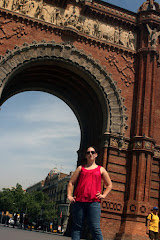
L'Arc de Triomphe- oh, one of my favorite things in Paris. Belonging to a military family has given me an intense appreciation for things militaristic in nature, and this especially. Patriotism was intensified by an enormous French flag displayed alongside an EU flag inside the arch, due to the EU headquarters moving to Paris.

It's in the middle of the scary traffic circle, known as Place Charles de Gaulle, which feeds no less than 12 streets, all named for famous military leaders. Traffic accidents inside the circle are equal fault of drivers involved- damages are split 50-50. A tourist enters the arch by way of damp underground tunnel, and is protected from said traffic by means of a flimsy chain strung round the monument. One tourist actually stepped over this barrier and out into traffic to take a photo of her group. She was quickly herded back by French policemen, but this sort of behavior is surely what prompted Dave Barry to write:
"Another well-known Paris landmark is the Arc de Triomphe, a moving monument to the many brave men and women who have died trying to visit it, which we do not recommend because it’s located in the middle of La Place de la Traffic coming from All Directions at 114 Miles Per Hour."
L and I spent some time reading the plaques and dedications inside the arch, which can be a difficult task since most are set into the ground and most tourists ignored us and walked over them while we stood there apparently concentrating on their migratory patterns. Not that I'm bitter.

Tomb of the unknown soldier

The Arch and the grave reminded me of one of the greatest scenes in the movie Casablanca:


Liberté, Liberté chérie, Combats avec tes défenseurs!


Avenue des Champs-Élysées, replete with gawking tourists such as myself

We needed food, so we left L'Arc de Triomphe via the Champs-Élysées and the Métro and went back to the fifth arrondissement.

Fontaine Saint-Michel in Quartier Latin

In the cities of Europe, there are so many restaurants that most establishments have developed a gimmick to attract customers. Some send out attractive men to verbally woo the ladies inside (creepier than it sounds), some have entertainers like musicians and jugglers outside to grab attention. This man was smashing crockery on the sidewalk.


We stopped to eat at a little crêperie (fancy French word for tasty pancake) near St-Michel that L knows and loves. It's called La Crêperie des Pêcheurs* (crêperie of the fishermen) and it looks like a ship's interior, complete with figureheads and fishing nets. The place is tiny. L and I were next to the door at a little table for two that was so small it was hinged to let me in to sit against the wall. It faced the open kitchen, and our pre-dinner entertainment were the masses of hungry tourists pausing mere steps away to consider the menu and have a peep at the atmosphere (naturally, us.) They serve both savory crêpes (salées) and sucrées (dessert), with le cidre, the traditional companion of a crêpe. I had something delicious with mushrooms and tomato, L and I shared a bottle of cidre, and then we ordered dessert. We chose the Grand Marnier crêpe flambé, which is served wreathed in blue fire and accompanied by a dish heaped with whipped cream and is very, very tasty.

*French punctuation makes this funny: a pêcheur (note the accent circumflex) is a fisherman. This word is but a mark away from being a pécheur (accent aigu), which is a sinner.


After dinner we stopped into a little English bookshop on the left bank of Seine called Shakespeare & Company. It's one of the 10 or so English-speaking bookshops in the city and is really a lovely little place. J'aime les librairies.

Maybe the next post will be less talk, more see. It's hard to write about places when the pictures make you miss it intensely, but hope remains! Possibly more on that later.

24 January 2009

Home of the UN and its Convention

Friday, 8 August 2008


European Adventure Travel Day 7
Geneva/Genéve/Genf, Switzerland

J's Geneva-based friends were kind enough to include me in their invitation to visit, so after we'd seen all there was to see in Neuchâtel, we moved on to the city that sparkles in the sun.

There is ground glass in the streets. The sparkles were the first thing we noticed.

We crossed the street to Migro's to do some grocery shopping, as J planned to make dinner for the four of us. We quickly found everything we needed for her recipe, except the capers. We searched high and low for them, in three different locations logical for the location of small, pickled, unopened flower buds, but to no avail. We asked store employees for help, but none of them had any idea what "capers" were, almost as if we were speaking a foreign language.

As it turns out, the French word for capers is "câpres," about as close as you can get in French. *facepalm* Good thing I know how to ask for "du vin."

Here is where I admit that I was busy interacting socially and didn't take many pictures in Geneva. I think the grand total was four. Not even kidding. J's friend A picked us up from the bus stop and took us on a mini-tour of the city before taking us to their flat.

People who work in glass buildings should be aware of that fact on Casual Friday

Saw the Jet d'Eau out of the window... Europe's tallest fountain and icon of Geneva. It originated on the Rhône in 1886, and shortly afterwards its tourist attraction potential was recognized and it was moved to its present location in Lake Léman (or Lake Geneva, if you haven't yet realized that Switzerland has at least two names for everything). To summarize: big tall stream of water in a lake.

Debated the visual impact of the Broken Chair monument to anti-personnel mine victims at Place des Nations. General consensus: something other than a legless chair could have been symbolic, yet more poignant depiction of landmine casualties.

Upon arrival at the flat of A and S, J commenced cooking, and A made me espresso. Several times. Dinner was good, the company was fabulous, and searching for French hostels futile.

22 October 2008

The Lion of Lucerne

Our next destination was Lucerne, but before I write about the city, I want to introduce you to my favorite monument, the Lion of Lucerne. In his book A Tramp Abroad, Mark Twain calls the Lion "the most mournful and moving piece of stone in the world."

(Clickable)
The Löwendenkmal - The Lion of Lucerne

The Swiss have been politically neutral for centuries. They also have a history of supplying mercenaries to foreign governments, and dignitaries trusted the Swiss Guards not to turn against them with shifting politics.

In 1792, after trying to escape the French Revolution, King Louis XVI, Marie-Antoinette and their children were hauled back to the Tuileries Palace in Paris, which was stormed by an angry mob of blood-thirsty Parisian revolutionaries. More than seven hundred Swiss officers and soldiers died there, unaware that the royal family was already gone.

The Lion of Lucerne was designed by Danish artist Bertel Thorvaldsen, and carved into the sandstone cliff of an old quarry in 1820 by Lucas Ahorn, a German stone-mason.

The Latin inscription HELVETIORUM FIDEI AC VIRTUTI means "To the loyalty and bravery of the Swiss". You'll also find the engraved names of the dead and of the saved officers of the Swiss guard, as well as the death toll among the Swiss soldiers (DCCLX = 760) and the number of surviving soldiers (CCCL = 350).


Because Mark Twain is more gifted with words than I, here is his description of the Lion:

"The Lion lies in his lair in the perpendicular face of a low cliff - for he is carved from the living rock of the cliff. His size is colossal, his attitude is noble. How head is bowed, the broken spear is sticking in his shoulder, his protecting paw rests upon the lilies of France. Vines hang down the cliff and wave in the wind, and a clear stream trickles from above and empties into a pond at the base, and in the smooth surface of the pond the lion is mirrored, among the water-lilies.

Around about are green trees and grass. The place is a sheltered, reposeful woodland nook, remote from noise and stir and confusion–and all this is fitting, for lions do die in such places, and not on granite pedestals in public squares fenced with fancy iron railings. The Lion of Lucerne would be impressive anywhere, but nowhere so impressive as where he is."

-Mark Twain, A Tramp Abroad, 1880


I think Twain is right. Somehow, standing before that pool of water in the unnatural stillness that is rarely found in the presence of a multitude of tourists, you can almost feel the lion's anguish. Because it touched me, I wanted to share it with you. And it doesn't have to be soldiers who died 200 years ago, but stop for a minute and remember those who have died defending others.